Good
- No annual fee and a free virtual card in every region
- 1.5% cashback from the first purchase in Brazil, Mexico and Argentina
- 3% cashback once you spend about $1,000 a month in most regions
- 0% FX fee in Colombia, Peru and Armenia
Watch out
- 0.9% conversion fee on every crypto-funded payment
- Cashback in Colombia, Peru and Armenia tops out at $20 a month
- FX fee of up to 7% in Argentina and 3% in Australia and New Zealand
- No physical card in Australia
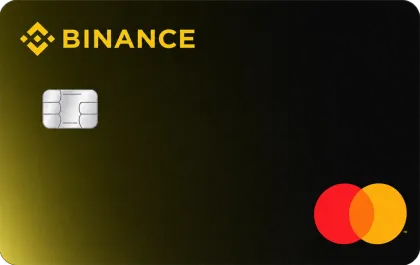
Binance Card is a free Mastercard that spends crypto straight from your Binance account, converting it at the moment you pay. In Brazil, Mexico, Argentina, Australia and New Zealand it pays 1.5% cashback from the first purchase and up to 3% for heavier spenders, and every crypto payment pays a 0.9% conversion fee.
Binance runs the card as several regional programs with different issuers, currencies and fees. Brazil and Argentina have local cards in reais and pesos issued by Pomelo, while Mexico, Colombia, Peru, Armenia, Australia and New Zealand get a dollar card from Immersve under Binance's Global Program. Pick your country at the top of the page and every table on this page switches to the terms for that program.
Binance Card cashback
Binance Card pays 1.5% to 3% cashback in most regions, with the rate set by how much you spend in a calendar month and applied to every purchase that month.
The tiers work backwards, which is unusual. If you cross the next threshold on the 25th, the higher rate is paid on everything you bought since the 1st. In Mexico, Australia and New Zealand, 1.5% applies below $100 a month, 2% from $100 and 3% from $1,000. The 3% tier is capped at $100 of cashback, which you reach at about $3,333 of spending.
Brazil and Argentina use the same rates in local money. Brazil's thresholds are R$500 and R$5,000 with a R$500 cap, and Argentina's are ARS 148,000 and ARS 1,480,000 with an ARS 148,000 cap. In both countries, payments funded from your reais or pesos balance earn no cashback, so only crypto-funded spending counts.
Colombia, Peru and Armenia get a weaker scale: 0.5% under $80, then 1%, 1.5% and finally 2% from $800, capped at $20 a month. That cap is reached at $1,000 of spending. Cashback is paid by the 10th of the next month, in BTC in Mexico and Argentina, in reais in Brazil and in USDC in Australia.
Binance Card fees
Binance Card has no annual fee or issuance fee for the virtual card, but each crypto-funded payment pays a 0.9% conversion fee and foreign-currency payments add an FX fee that depends on your country.
The conversion fee is the cost you pay on every purchase, because Binance sells your crypto for money at checkout. In Mexico, Australia and New Zealand, spending USDC cuts it to 0.1%, so setting USDC first in your payment priority is the cheapest option. In Brazil and Argentina, spending your reais or pesos balance avoids the fee entirely, but those payments earn no cashback.
The FX fee is where the regions differ most: Colombia, Peru and Armenia pay 0%, Mexico pays 2%, Brazil pays up to 2%, and Australia and New Zealand pay 3%. Argentina charges 6% to 7%, which makes the card expensive abroad for Argentine users. The Global Program card is held in dollars, so in Australia and New Zealand the 3% fee also applies to everyday payments in local currency.
The physical card is free in Brazil (with at least 10 USDT in your account) and in Argentina until December 31, 2026. In Mexico it costs $10 with standard shipping.
Binance Card ATM withdrawal fees
Binance Card gives two free ATM withdrawals a month on the physical card in Brazil, Mexico and Argentina, then charges $1.50 per withdrawal.
The flat fee makes large withdrawals cheap: $1.50 on a $200 withdrawal is 0.75%, plus the 0.9% conversion fee if you withdraw from crypto and whatever the ATM owner charges. Withdrawals don't count toward cashback tiers. Brazil and Argentina allow up to 3 ATM withdrawals a day and 30 a month.
Australia has a virtual card only, so cash withdrawals aren't available there, and Binance doesn't publish ATM terms for Colombia, Peru, Armenia or New Zealand.
Is Binance Card safe?
Binance Card is custodial: the card spends crypto that Binance holds for you in your Spot, Funding and Earn accounts.
The card itself is issued by licensed partners rather than Binance. Immersve, a New Zealand company licensed by Mastercard, issues the Global Program card, and its Australian arm holds an Australian financial services licence. In Brazil the issuer is Pomelo, regulated by the Central Bank of Brazil, and in Argentina it is Pomelo's local company, authorised by the Central Bank of Argentina.
Your balance is only as safe as your Binance account, so turn on two-factor authentication, keep on the exchange only what you plan to spend with the card, and hold savings elsewhere.
Who should get Binance Card
Binance Card suits people in Brazil, Mexico and Argentina who already keep crypto on Binance and want rewards from the first purchase.
At $500 a month in Mexico you earn 2%, which is $10 a month, while the conversion fee on the same spending is $4.50, or $0.50 if you pay with USDC. Spending $1,000 a month moves you to 3%, worth $30. In Australia and New Zealand the 3% FX fee on local-currency payments wipes out that cashback, and in Colombia, Peru and Armenia the $20 monthly cap limits the upside.
For Argentine users, the 6% to 7% FX fee makes Binance Card a poor choice for travel, though it works well for local spending. The comparison below shows the alternatives in your country.

Where Binance Card is available
Binance Card is available to verified Binance users in Brazil, Argentina, Mexico, Colombia, Peru, Armenia, Australia and New Zealand.