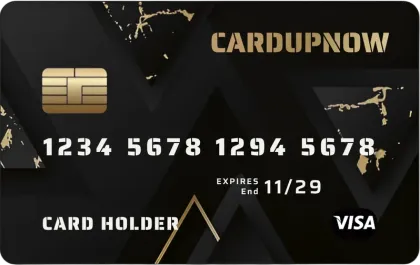
Visa / Mastercard
Good
- No ID checks, sign-up needs only an email and password
- Funded with USDT, USDC, BTC, ETH or TRX
- CardUp Elite drops the load fee after a single $300 recharge
- Choice of Visa or Mastercard, issued instantly
Watch out
- $50 activation fee that can't be spent on a card
- 5% fee every time you load a standard card
- No cashback or rewards on any spending
- Virtual only, with no physical card for shops or ATMs
CardUpNow Virtual Card is a prepaid virtual Visa or Mastercard that you fund with crypto and use online without any identity checks. Opening an account costs $50 once, each standard card load costs 5%, and the card pays no cashback.
CardUpNow pitches its cards at advertisers, freelancers and anyone paying for subscriptions or free trials who wants to keep a bank card out of the checkout. You sign up with an email address, deposit crypto, and create as many cards as you need from one dashboard.
CardUpNow Virtual Card cashback
CardUpNow Virtual Card pays no cashback on either of its plans, so every dollar you spend costs a dollar plus fees.
The FAQ says CardUpNow occasionally runs reward or cashback campaigns linked to promotions or active use, without giving a rate, a duration or the cards they cover. That is not something to plan around.
The gap is easy to put in numbers. At $1,000 of spending a month, a free card paying 1% would return $10 a month, or $120 a year. With CardUpNow Virtual Card you get nothing back and pay a 5% load fee on top, unless you qualify for CardUp Elite.
| Plan | To unlock | Base cashback | FX fee | Card |
|---|---|---|---|---|
 Visa Visa MastercardVisa / Mastercard MastercardVisa / Mastercard | Free | 0% | — | —, virtual $50 |
 CardUp Elite CardUp Elite | Hold $300 | 0% | — | —, virtual $50 |
CardUpNow Virtual Card fees
CardUpNow Virtual Card costs $50 to activate and charges 5% each time you load a standard card, according to CardUpNow's fees and usage policy.
The $50 activation fee is paid once per account, can't be refunded and can't be loaded onto a card. CardUpNow asks for a first deposit of at least $100, so a new user who wants $95 on their first card pays $55 in CardUpNow fees before spending anything.
The 5% load fee is the cost that repeats. Loading $100 onto a standard card leaves $95 to spend, and loading $1,000 a month costs $50, which adds up to $600 a year. CardUp Elite removes this fee once you have recharged $300 or more in a single deposit, so heavy users should go straight to Elite.
The fee schedule also lists a 5% deposit fee on wallet top-ups and a 5% fee on wallet withdrawals, while CardUpNow's TRON page says TRX deposits carry no CardUpNow deposit fee. Small USDT deposits pay an extra $1 handling fee, so CardUpNow recommends sending at least $100 at a time.
Smaller charges come from how you use the card. A declined payment costs $0.40, any payment under $30 costs an extra $0.40, and if more than 20% of your payments are refunded after five uses, each refund costs $0.50 or 2%, whichever is higher. CardUpNow doesn't list an FX fee for payments in currencies other than the dollar.
CardUpNow Virtual Card ATM withdrawal fees
CardUpNow Virtual Card has no published ATM fees, and every card CardUpNow issues is virtual, so there is no physical card to put in a cash machine.
The fees policy covers activation, deposits, card loads, withdrawals back to your wallet and declined payments, with no line for cash. If you need to turn crypto into cash regularly, use a card that comes in plastic and lists its ATM costs.
Is CardUpNow Virtual Card safe?
CardUpNow Virtual Card is custodial: once you deposit crypto, the balance sits in your CardUpNow wallet and on the cards you create, not in a wallet you control.
CardUpNow describes itself as a virtual card platform that is not a bank or a traditional financial institution, and its site doesn't name the bank or card processor behind the Visa and Mastercard cards. Because there is no identity check, there is also no regulated account in your name that a deposit protection scheme would cover.
The terms limit what you can recover if something goes wrong. CardUpNow's liability is capped at the fees you paid in the 90 days before a claim, issued cards can't be refunded, and the company can suspend accounts it considers high risk without notice or refund. Keep only what you plan to spend soon on the platform.
Who should get CardUpNow Virtual Card
CardUpNow Virtual Card suits people who need several throwaway or reloadable cards for ad accounts, software trials and subscriptions, and who value signing up without ID more than they value low fees.
For that use, CardUp Elite is the plan to aim for. After the $50 activation fee and a single $300 recharge, Elite cards have no issuance, reload or transaction fee, which makes the platform far cheaper for anyone spending a few hundred dollars a month on ads.
For everyday spending the numbers don't work. A free card with no conversion fee and 1% cashback would leave you $60 better off on every $1,000 spent compared with a standard CardUpNow card, and it would come with a physical card as well. The comparison below shows cheaper options in your country.



Where CardUpNow Virtual Card is available
CardUpNow Virtual Card is offered to users worldwide, including the United States and the United Kingdom, with use in sanctioned countries banned by its terms.
CardUpNow doesn't publish a country list, and the cards work at any online merchant that accepts Visa or Mastercard. Signing up only needs an email address, so the quickest check for your country is to open an account before making the $50 activation payment.