Good
- Virtual card fee from $25
- Top up USDT or USDC on 7 networks, including Tron and Solana
- Physical card withdraws cash for 2% (min $1) per withdrawal
- No fee on transfers between KazePay users
Watch out
- No cashback on any of the 3 cards
- 1.8% to 2.2% fee on every virtual card top-up
- Liability capped at the fees you paid in the previous 12 months
- Card top-ups are capped at $500 each
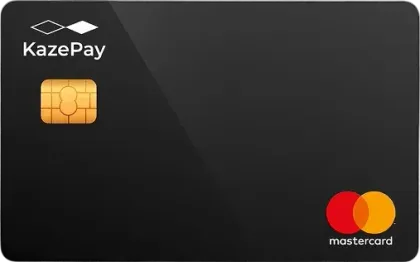
KazePay Card is a prepaid card you load from USDT or USDC in the KazePay app. Virtual cards cost $25 (Silver) or $49 (Gold), and the physical card costs $99. There's no cashback, and instead of a spending fee KazePay charges 1.8% to 2.2% on each virtual card top-up and 2% on the physical card.
Each card is a separate product with its own card fee and recharge rate, and one account can hold several. The physical card is the only one that withdraws cash.
KazePay Card cashback
KazePay Card pays no cashback on any of its three cards, Silver, Gold or Physical.
The difference between the virtual tiers is cost and limits. Silver has the standard annual spending limit and the basic recharge rate. Gold costs $24 more and has a higher annual limit and a lower recharge fee, aimed at frequent users. KazePay's pricing page doesn't state the annual limits in dollars.
Gold only makes sense if its lower recharge fee saves more than the $24 difference, and at 1.8% on Gold against 2.2% on Silver that takes $6,000 of top-ups.
KazePay Card fees
KazePay Card charges no fee when you spend, but every top-up costs 1.8% to 2.2% on the virtual cards and 2% on the physical card.
Every dollar you spend has to be loaded onto the card first, so the top-up fee works like a spending fee. At the Silver card's 2.2%, a $100 purchase costs $102.20 in practice.
KazePay doesn't list an FX fee for payments in other currencies, though its terms say conversions can include exchange rates, spreads and processor fees, so expect some extra cost abroad.
Each top-up is capped at $500. Loading $2,000 for a month of spending takes four top-ups and costs about $44 at 2.2%.
Deposits come in as USDT or USDC on BNB Smart Chain, Solana, Aptos, Tron, Base, Avalanche or Arbitrum. Transfers between KazePay users are free.
KazePay Card ATM withdrawal fees
KazePay Card supports ATM withdrawals only on the $99 physical card, at 2% per withdrawal with a $1 minimum.
The Silver and Gold cards are virtual and can't withdraw cash. On the physical card, a $200 withdrawal costs $4 in KazePay fees, before the ATM owner's charge and the 2% top-up fee on the money you loaded. The $1 minimum only matters on withdrawals below $50. Limits are $1,500 a day across up to 6 withdrawals, and $15,000 a month.
Is KazePay Card safe?
KazePay Card is custodial: KazePay holds your balance, and it says user funds are safeguarded with regulated banking partners that it doesn't name.
KazePay says it's operated by METABANK INC in the US and INFI TECH in Hong Kong, under the parent company KAZEFI. Its terms say KazePay isn't the card issuer and that funds may be held by KazePay, its affiliates, custodians, issuers or banks, without saying which.
The terms also cap KazePay's liability at the fees you paid in the previous 12 months. With that cap and no named issuer, it's sensible to keep only spending money on the account. Accounts are protected with multi-factor authentication and device binding.
Who should get KazePay Card
KazePay Card suits people who hold USDT or USDC on networks such as Tron, Solana or Aptos and want a card they can load from those balances, especially if they need a physical card for cash.
For everyday spending, the top-up fee makes it expensive. At around 2%, $1,000 of monthly spending costs about $20 a month, with no cashback in return and no listed FX fee for foreign payments.
Someone who only needs a virtual card for occasional online payments in dollars can live with that. Regular spenders and travellers will pay less with a card that has a published FX fee and some cashback. The comparison below shows the strongest alternatives in your country.



Where KazePay Card is available
KazePay Card works in 210 countries, according to KazePay, though physical card availability depends on your country of residence.
Identity verification is required before a card is issued, and KazePay's terms bar use from prohibited jurisdictions, so KazePay asks users to check eligibility with support.