Good
- No issuance fee, no monthly fee and no minimum balance
- 5% cashback at Talabat, Keeta and Noon, 3% on Careem and Uber
- Works with Apple Pay and Google Pay from the first day
- Spends USDT directly, with no bank account needed
Watch out
- 1% transaction fee on every purchase, in shops and online
- Card terms allow up to 3% on non-dollar payments
- No published cashback rate outside partner merchants
- Not for US citizens or residents of India, Turkey or Russia
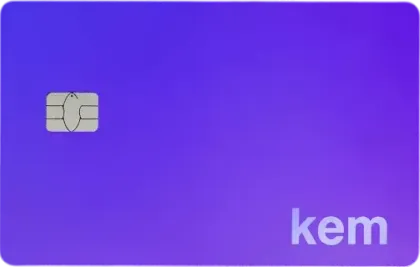
Kem Card is a free virtual Visa card that spends the USDT balance in the Kem app. It has no issuance or monthly fee, charges 1% on every purchase, and pays up to 5% cashback at partner merchants such as Talabat, Careem and Emirates. Kem builds it for residents and expats in the Gulf states.
Kem is a stablecoin money app based in Abu Dhabi that lets you hold USDT, Bitcoin, Ethereum and Tether Gold, send them to other users and swap them for local currencies such as dirhams, riyals and dinars. The card is the spending side of that balance, and it's issued in the app within minutes after an ID check and a face scan, ready to add to Apple Pay or Google Pay.
Kem Card cashback
Kem Card pays cashback only at named partner merchants: 5% at Talabat, Keeta and Noon, and 3% on Careem and Uber rides and Qatar Airways, Emirates and Etihad flights.
Kem doesn't publish a cashback rate for purchases outside those partners. For people in the Gulf who order food delivery several times a week, the partner rates still add up. $200 a month on Talabat earns $10 at 5%, and the 1% purchase fee takes $2 of that back, so the net return on those orders is about 4%.
Rides and flights work the same way at 3%. A $600 Emirates ticket earns $18 back, and after the 1% fee you keep $12. Cashback is automatic, with nothing to activate and no minimum spend, and Kem credits it to your Kem balance.
The weak spot is everything else on the card: groceries, fuel, subscriptions and shopping outside the partner list pay the 1% fee with no published reward to offset it, so the card costs money on most of a typical month's spending.
Kem Card fees
Kem Card has no issuance fee, no monthly fee and no minimum balance, but Kem charges a 1% transaction fee on every purchase, both in shops and online.
The 1% is the cost of turning USDT into the dollars the card spends, and Kem lists it as the USDT-to-USD fee on its homepage. On $1,000 of monthly spending that's $10, or $120 a year, which is more than many free cards charge for spending stablecoins.
Payments in a currency other than US dollars can cost more. Kem's card terms allow a foreign exchange fee of up to 3% on non-dollar payments and a cross-border fee of up to 3%. Since most Gulf currencies aren't dollars, check the fee on the receipt in the app after your first local purchase, because a dirham or riyal payment counts as a foreign-currency payment for a dollar card.
The card itself is free to open, and Kem lets you pick from several card designs and change the design later in the app. Sending money to other Kem users inside the app is free, while withdrawals to banks or external wallets carry a fee shown in the app before you confirm.
Kem Card ATM withdrawal fees
Kem Card isn't built for cash, because Kem's card terms say cash advances aren't available and Kem doesn't publish any ATM fee for the card.
If you need cash in the Gulf, Kem's route is to withdraw your balance to a linked bank account in the app, which usually takes from a few minutes to half an hour, and then use your bank card at the ATM.
Is Kem Card safe?
Kem Card is custodial: your USDT, Bitcoin and other assets sit in your Kem account, and Kem uses Fireblocks for digital asset custody.
The card is issued by Third National under licence from Visa. Kem Technologies Holding Ltd is registered in the Abu Dhabi Global Market, and Tether, the company behind USDT, invested $3 million in Kem in 2024. Kem says its card program is PCI DSS compliant, assessed by ControlCase, and that Chainalysis screens transactions for blacklisted funds.
Kem states in its app listing that it's a crypto financial platform and not a bank, so your balance doesn't have the deposit protection a bank account would. You can lock the card from the card page in the app if you notice a payment you don't recognise. As with any app that holds your crypto, keep only what you plan to spend.
Who should get Kem Card
Kem Card suits GCC residents who already hold savings in USDT and spend regularly on food delivery, ride-hailing and Gulf airlines through Kem's partners.
For that pattern the card pays for itself. 5% on food delivery and 3% on rides and flights leave a net 2–4% after the 1% fee, which is better than most free crypto cards pay.
For anyone whose spending is mostly outside those partners, the sums turn negative. The 1% purchase fee applies everywhere, and non-dollar payments can cost up to 3% more under the card terms, so a card with no conversion fee and a flat cashback rate will cost less. The comparison below shows the options in your country.
Where Kem Card is available
Kem Card is built for residents and expats in Saudi Arabia, the United Arab Emirates, Bahrain, Qatar, Oman and Kuwait, and it works wherever Visa is accepted.
Kem can't issue the card to US citizens, or to residents of Belarus, China, Cuba, India, Iran, Iraq, Israel, Myanmar, Nepal, Nicaragua, North Korea, Russia, Syria, Turkey, Ukraine, Venezuela or Vietnam. You need the Kem app on iPhone or Android and an ID check to get started.