Good
- Premium removes all card fees and pays 1% for a refundable $1,000 lock
- 0% fee on purchases and on payments in other currencies
- Funded with USDT, USDC, BTC, ETH, SOL, Monero and other coins
- Free crypto deposits and free card creation
Watch out
- 5% fee on every card load on the Standard plan
- Virtual only, with no physical card for shops or ATMs
- Standard accounts are limited to 5 active cards
- Rivocard doesn't name the bank that issues its cards
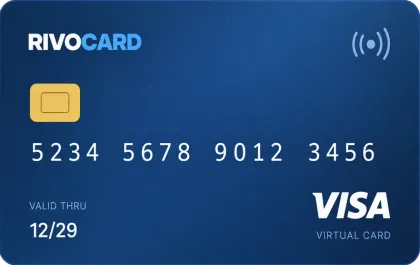
Rivocard Virtual Card is a prepaid virtual Visa that you fund with crypto and use for online payments. Opening an account and creating a card are free, each card load costs 5% on the Standard plan, and the card pays 1% cashback only if you lock $1,000 for Premium.
Rivocard is built for paying ad platforms, AI tools, software subscriptions and online stores with crypto instead of a bank card. You deposit coins into a Rivocard wallet, move a dollar amount onto a virtual card, and use the card number, expiry date and CVV at checkout. Payments in other currencies cost nothing extra.
Rivocard Virtual Card cashback
Rivocard Virtual Card pays 1% cashback on the Premium plan and nothing on the free Standard plan.
Premium has no monthly price, because Rivocard instead moves $1,000 of your balance into a locked bucket, and the money stays yours as long as it sits there. While it is locked, Rivocard credits 1% of your card spending to your wallet each month. If you unlock the $1,000, it comes back to your available balance after a 24 to 48 hour security hold and the cashback stops straight away.
The 1% is the smaller part of the deal. At $1,000 of card spending a month, Premium pays $10 back, but it also saves the $50 that the same $1,000 would cost in load fees on Standard. Together that is $60 a month, or $720 a year, in favour of Premium for anyone who can spare the $1,000.
Rivocard Virtual Card fees
Rivocard Virtual Card has one fee on the Standard plan, 5% of every amount you load onto a card, according to Rivocard's fees page.
The fee is taken from the amount you load, so a $100 load leaves $95 on the card and a $1,000 load leaves $950. It applies on the first funding and on every reload after that, whether the money came in as crypto or by bank transfer. Rivocard suggests loading larger amounts less often, but the percentage stays the same, so the only real way to cut it is Premium.
Everything around the card is free. Crypto deposits into the wallet cost nothing, and so do creating a card, freezing it, replacing it, closing the account and declined payments. There is no monthly fee and no charge on purchases. Payments in euros, pounds or any other currency don't carry an FX fee, which is rare for a crypto card and useful for anyone paying foreign software or ad invoices.
Premium removes the 5% load fee too, so a Premium account pays no Rivocard fees at all. The cost of Premium is the $1,000 that stays locked and can't be spent while the membership is active.
Rivocard's site says cards start from a $50 balance, so plan your first deposit around that amount.
Rivocard Virtual Card ATM withdrawal fees
Rivocard Virtual Card can't be used at ATMs, because every Rivocard card is virtual and made for online payments.
There is no plastic card to order, and Rivocard's fee page has no line for cash withdrawals. You can move unspent money back out as crypto, which Rivocard processes instantly, or by bank transfer in one to two business days, with no exit fee. If you need cash from a machine, use a crypto card that comes with a physical card.
Is Rivocard Virtual Card safe?
Rivocard Virtual Card is custodial: the crypto you deposit becomes a balance held by Rivocard, not coins in a wallet you control.
Rivocard calls itself a financial technology platform that is not a bank, and says its cards come from licensed third-party issuing partners without naming them. The company behind the site is Rivocard Ltd, which says it was founded in 2026, so it has a short track record.
The terms limit what you can recover if something goes wrong. Rivocard's liability is capped at the fees you paid in the 90 days before a claim, load fees can't be refunded once processed, and the AML policy lets Rivocard freeze funds during an investigation. Crypto sent to the wrong address or network can't be recovered either. Keep only what you plan to spend soon on the platform, and lock $1,000 for Premium only if you can afford to have it tied up.
Who should get Rivocard Virtual Card
Rivocard Virtual Card suits people who pay ad accounts, AI tools and software in other currencies with crypto, and who can keep $1,000 locked to get Premium.
On Premium the card has no load fee, no FX fee and 1% back, which beats most crypto-funded virtual cards for online spending. Advertisers with several campaigns also get unlimited cards on Premium, against 5 on Standard.
On the Standard plan the numbers are much weaker. Paying 5% to load means $50 on every $1,000 you spend, or $600 a year at that level, and many free crypto cards charge 1 to 2% or less. The card also has no physical version, so it can't replace a debit card for shops or cash. The comparison below shows cheaper options in your country.


Where Rivocard Virtual Card is available
Rivocard Virtual Card works at online merchants that accept Visa, and Rivocard says its cards are accepted in more than 150 countries.
Rivocard doesn't publish a list of countries where you can open an account, but its AML policy screens every user against US, EU and UN sanctions lists. Signing up is free, so the quickest check for your country is to create an account before sending any crypto.