Good
- No monthly or annual fee on either card
- 0% top-up fee on the Platinum card
- Virtual card needs no ID check and is issued in about 30 seconds
- Loads from USDC, USDT, SOL or SOLC
Watch out
- No cashback on any card
- Virtual card charges 5% per top-up plus $10 per new card
- Virtual card is capped at $5,000 a month and works online only
- Terms allow a dormancy fee of 10% of the balance per month
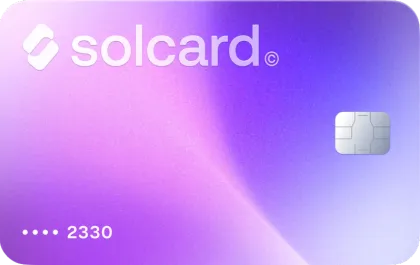
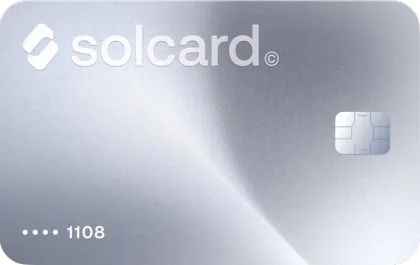
SolCard is a prepaid Visa card that you load with USDC, USDT, SOL or SOLC and then spend in US dollars. There's no monthly or annual fee and no cashback, and the Platinum card has a 0% top-up fee but needs an ID check, while the Virtual card needs no ID but charges 5% on every top-up.
SolCard runs these as two versions with different terms, both offered in the same countries.
SolCard cashback
SolCard pays no cashback on either the Platinum or the Virtual card, so the choice between them comes down to fees, limits and the ID check.
Platinum is the card for regular spending, with no monthly limit and nothing to pay on top-ups. It works in shops and online, and it adds to Apple Pay and Google Pay.
Virtual is for online payments only. It's capped at $5,000 a month, the minimum top-up is $50, and it's issued in about 30 seconds without an ID check. The 5% top-up fee is the price of skipping verification: loading $1,000 costs $50, and loading the full $5,000 monthly limit costs $250.
| Plan | To unlock | Base cashback | FX fee | Card |
|---|---|---|---|---|
 Platinum Platinum | Free | 0% | 1.5% | — |
| Plan | To unlock | Base cashback | FX fee | Card |
|---|---|---|---|---|
 Virtual Virtual | Free | 0% | 2% | — |
SolCard fees
SolCard has no monthly or annual fee; the costs come from topping up the card and paying in foreign currencies.
On Platinum, topping up is free, and SolCard's fee page quotes the foreign-exchange spread as a range of roughly 0 to 1.5% without saying which payments land where.
On Virtual, each top-up costs 5%, and every new card adds a one-time $10 issuance fee. The FX spread is quoted as roughly 1 to 2%. A $100 purchase abroad on Virtual effectively costs about $7 once you include the 5% you paid to load it.
Two charges in the terms are easy to miss. A dormancy fee of 10% of the remaining balance per month can apply, and the terms don't state when an account counts as dormant. Too many declined payments carry a handling fee, and on Virtual, 10 declines in a row or a decline rate above 20% cancels the card.
SolCard ATM withdrawal fees
SolCard Virtual can't be used at ATMs, and SolCard doesn't publish ATM fees or limits for the Platinum card.
SolCard's virtual card page says the card may not work in stores, at ATMs or for some recurring checkouts. For Platinum, neither the fee page nor the terms mention cash withdrawals, so if you need cash from a crypto card, pick one with a published ATM fee.
Is SolCard safe?
SolCard is custodial: once you load crypto, the balance sits with the card program as a prepaid dollar balance, not in a wallet you control.
SolCard is run by SC Payments Limited, a Hong Kong company. According to its terms, SolCard doesn't issue cards or hold client funds in its own accounts. A third-party licensed financial institution or e-money institution issues the card under a Visa license, but SolCard doesn't name it.
SolCard says it isn't a bank and balances aren't FDIC-insured. There's no credit line, so you can only spend what you've loaded. The terms also allow a 10% monthly dormancy fee on idle balances, so keep only what you plan to spend on either card.
Who should get SolCard
SolCard Platinum suits people who hold USDC, USDT or SOL and want a free way to spend it, with no top-up fee and no monthly limit.
SolCard Virtual suits a narrower need, an online card without an ID check, and you pay heavily for it. The 5% top-up fee on $500 of monthly spending is $25 a month, or $300 a year, before any FX spread.
Neither card pays anything back, so if you're happy to verify your identity, a card with cashback will beat SolCard on the same spending. The comparison below shows the alternatives in your country.


Where SolCard is available
SolCard is available in most countries, including the United States, but not in Hong Kong or in countries under comprehensive sanctions.
SolCard doesn't publish a full country list. Its terms exclude Hong Kong residents and companies, and any country or territory under comprehensive UN, US, EU or UK sanctions. A dedicated page says SolCard is available to residents across the US and asks applicants to check signup for their state.