Good
- Only 0.5% to move USDC onto the card, card payments cost 0%
- No FX markup on payments in euros, pounds or other currencies
- Works in Apple Pay and Google Pay from day one
- One-off $10 card fee, no monthly or annual charge
Watch out
- No cashback on any spending
- Virtual only, the physical card is on a waitlist
- No ATM withdrawals
- Card balance is capped at 5,000 USDC
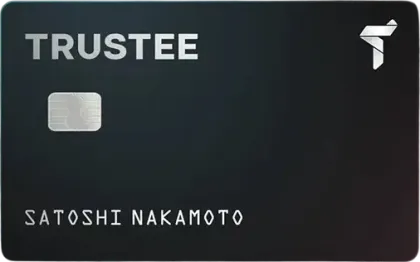
Trustee Plus Card is a virtual Visa debit card in US dollars that you fund with USDC from the Trustee Plus crypto wallet. It costs $10 once to issue, charges 0.5% on each top-up and nothing on card payments. It pays no cashback, so its value is in cheap spending.
The card has its own balance, separate from your wallet. You move stablecoins onto it when you want to spend, up to 3,000 USDC per top-up and 5,000 USDC on the card at any time, and you can set an automatic top-up that refills it when the balance runs low.
Trustee Plus Card cashback
Trustee Plus Card doesn't pay any cashback, points or token rewards on card payments.
That puts it behind most crypto cards on rewards, since many free cards pay at least 1% on some of your spending. What the Trustee Plus Card does instead is keep costs low: the only charge on everyday spending is the 0.5% top-up fee, so the card is a way to spend stablecoins cheaply rather than a way to earn.
If rewards matter to you, compare the plans below with the alternatives further down the page, because any card that pays even 1% back will come out ahead of the Trustee Plus Card for someone who spends a few hundred dollars a month.
Trustee Plus Card fees
Trustee Plus Card has a one-off $10 issuance fee, a 0.5% fee on each top-up in USDC, and no fee on card payments.
The top-up fee is the cost of turning stablecoins into card money, and it's the main cost you'll pay. Moving $1,000 onto the card costs $5, so someone spending $1,000 a month pays about $60 a year, on top of the $10 card fee in the first year.
Payments in other currencies don't carry an FX fee from Trustee Plus. The card is in dollars, and a payment in euros, zlotys or pounds is converted at the market rate with nothing added on top, according to Trustee Plus. That makes the card cheaper abroad than many crypto cards, which add 1–2% to every foreign-currency payment.
There is no monthly fee and no inactivity fee, so a card you use once a month costs nothing to keep. The monthly spending limit is 30,000 USDC, which is far above what most people will need.
Trustee Plus Card ATM withdrawal fees
Trustee Plus Card doesn't support ATM withdrawals, so you can't take cash out with it.
The physical card was meant to cover cash and chip payments, but Trustee Plus lists it as temporarily unavailable. Until it returns, anyone who needs cash abroad will need a second card.
Is Trustee Plus Card safe?
Trustee Plus Card is custodial: your wallet runs in the Trustee Plus app, and the money you move onto the card is held for the card by its issuer.
The card is issued by Wirex Limited, a company registered in England, and the Trustee Plus app is run by MIKEPAY INC., a company registered in Panama, according to the Trustee Plus terms of use. Trustee Plus published penetration tests of its iOS and Android apps by the security firm Hacken in February 2025, and both reports are linked from its website.
The card balance is capped at 5,000 USDC, which limits how much sits on the card at any time. Keeping only what you plan to spend on the card, and the rest in your wallet, is the sensible way to use it.
Who should get Trustee Plus Card
Trustee Plus Card suits people who already hold USDC in Trustee Plus and want a cheap way to spend it online and through their phone. A 0.5% top-up fee and no FX markup make it one of the cheaper ways to pay in another currency with stablecoins.
It's a weaker choice if you want to earn rewards, withdraw cash or pay with a plastic card, because it does none of those today. In that case the cards below are worth comparing first.



Where Trustee Plus Card is available
Trustee Plus Card is aimed at Trustee Plus users in Europe, and in March 2025 Trustee Plus opened its virtual card to adults with a residential address in the European Economic Area.