Good
- Sign-up needs only an email address, with no ID documents
- Loads from 135+ coins across 35+ networks, including XMR
- No monthly fee and no FX markup from WaldenPay
- Top-up fee falls from 5% to 3% as 30-day spending grows
Watch out
- 5% top-up fee on the first $2,000 of monthly spending
- No cashback or rewards on any plan
- Virtual card only, with no plastic card yet
- Balance on a closed account is returned only at WaldenPay's discretion
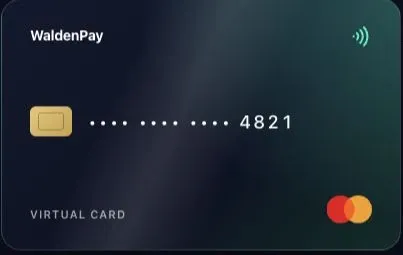
WaldenPay Virtual Card is a prepaid US dollar card that you load with crypto and sign up for with only an email address. It costs $10 to issue and charges 5% on each top-up, falling to 3% for very heavy spenders, with no monthly fee and no cashback.
WaldenPay accepts more than 135 coins across 35 networks, from USDT on Tron to Monero, and converts each deposit into a dollar balance when you load the card. The card then works online, through Apple Pay and Google Pay, and anywhere the card networks are accepted. The price of that convenience is the top-up fee, which is the main cost to understand before you send any crypto.
WaldenPay Virtual Card cashback
WaldenPay Virtual Card pays no cashback, points or token rewards on any spending, at any volume.
The tiers WaldenPay advertises are fee discounts rather than reward levels. Spending more lowers the percentage you pay to load the card, but nothing comes back to you after a purchase.
For comparison, a card paying 1% on $1,000 of monthly spending would return $120 a year. On WaldenPay, the same $1,000 a month costs $50 in top-up fees at the standard rate, so the gap against a cashback card is wider than it looks.
WaldenPay Virtual Card fees
WaldenPay Virtual Card charges a $10 one-time issue fee and a top-up fee of 5% on every load, according to WaldenPay's pricing page.
The top-up fee is taken from the amount you load, so $100 of USDT becomes a $95 card balance. The rate drops as your card spending over a rolling 30 days grows: 4.75% from $2,000, 4.5% from $5,000, 4.25% from $10,000, 4% from $25,000, 3.5% from $50,000 and 3% from $100,000. Above $250,000 a month WaldenPay sets individual pricing.
Those discounts matter mostly to media buyers and agencies funding ad accounts. Someone spending $500 a month stays on 5% and pays about $300 a year in top-up fees, which is the real annual cost of the card even though there is no subscription.
The card balance is held in US dollars, and payments in other currencies are converted at the card network's rate. WaldenPay says it adds no foreign transaction markup of its own, so a purchase in euros costs only the network's exchange spread on top of the top-up fee you already paid.
Blockchain network fees come on top and go to the network rather than WaldenPay: stablecoins sent over Tron usually cost under $1 to transfer, while Ethereum fees depend on congestion. The minimum top-up is $25, and there is no inactivity fee or monthly maintenance charge.
WaldenPay Virtual Card ATM withdrawal fees
WaldenPay Virtual Card is a virtual card only, and WaldenPay publishes no ATM withdrawal option or cash fee for it.
You can still pay in shops by adding the card to Apple Pay or Google Pay. WaldenPay says a physical card is on its roadmap, but until it arrives anyone who needs cash will need a different card.
Is WaldenPay Virtual Card safe?
WaldenPay Virtual Card is custodial: once you deposit crypto, it becomes a dollar balance held by WaldenPay and its card partners rather than coins in your own wallet.
WaldenPay is run by BlueHouse Software B.V., a company registered in Rotterdam in the Netherlands, and it says plainly that it is not a bank. Cards, custody and crypto conversion are provided by licensed third-party partners that WaldenPay doesn't name on its site.
The terms are worth reading before you load a large amount. WaldenPay can close accounts at its discretion, including after long inactivity, and says remaining balances on a closed account may be returned at its discretion, minus fees. Its liability is capped at the fees you paid in the previous 12 months.
On the account side, WaldenPay supports two-factor authentication, lets you freeze a card from the dashboard, and processes card data through PCI DSS-compliant partners. Email-only sign-up keeps your documents off the platform, but WaldenPay still screens payments under anti-money-laundering rules, so it isn't an anonymous card.
Who should get WaldenPay Virtual Card
WaldenPay Virtual Card suits people who hold coins that most cards won't take, want a dollar card within minutes, and would rather not upload an ID.
Freelancers paid in crypto can use WaldenPay's free Collect Payments links to get paid and then load the card from the same wallet. Sending money to another WaldenPay user by email is free, which makes it easy to split costs with someone already on the platform.
For everyday spending the 5% top-up fee is the problem, because most crypto cards charge 1% to 2% to convert and some pay cashback on top. The comparison below shows cards in your country with lower costs per purchase.


Where WaldenPay Virtual Card is available
WaldenPay Virtual Card is open to residents of almost every country, with sign-up blocked only in a short list of sanctioned or high-risk jurisdictions.
The excluded places are North Korea, Iran, Syria, Cuba, Russia, Belarus, Afghanistan, Myanmar and the Crimea, Donetsk and Luhansk regions of Ukraine. WaldenPay names the European Union, the UK, Nigeria, Turkey, India and Brazil among its busiest markets.