Good
- Virtual card for $5, with no annual or monthly fee
- USDC stays in your own wallet as collateral, not with Decaf
- Apple Pay and Google Pay on the digital card
- Physical card for $10 in the US, with a 1% FX fee
Watch out
- No cashback or rewards on any spending
- Physical card costs $90 outside the US
- Only USDC can fund the card
- Not offered in India, Turkey, Nigeria, Vietnam or 12 US states
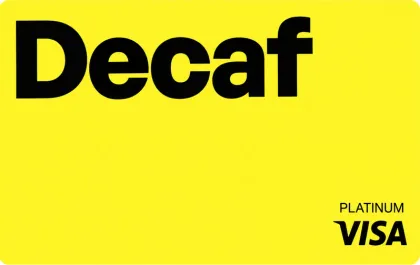
Decaf Card is a Visa card that spends USDC from the self-custody Decaf wallet, with a $5 virtual card, a physical card from $10 and no monthly fee. US cardholders pay 1% on foreign-currency payments, and the card pays no cashback.
Decaf started as a non-custodial wallet on Solana and Stellar and now also runs payment links and business payments. The card sits inside the personal account, where you receive money by link, bank transfer or USDC, then spend it by card. US residents get the card under a separate US agreement, so pick your country at the top of the page to see the right terms.
Decaf Card cashback
Decaf Card pays no cashback, and Decaf doesn't run a points or token rewards scheme on card spending.
There is also only one card level, so no paid tier, staking or spending target changes what you earn. The case for the Decaf Card rests on low fees and keeping control of your USDC, so if rewards matter to you, a card that pays even 1% on spending will return more.
Decaf Card fees
Decaf Card has no annual or monthly fee, and the main costs are the one-off card price and the fee on foreign-currency payments.
The virtual card costs $5 in every country. A physical card costs $10 in the US and $90 everywhere else, which is a steep price for plastic outside the US when the virtual card works with Apple Pay and Google Pay for most in-store payments.
In the US, the cardholder agreement sets a 1% international transaction fee on payments in other currencies or outside the country, so a $500 hotel bill abroad costs $5 extra. Outside the US, payments use Visa's exchange rate plus a foreign exchange fee that the card terms cap at 2%, and Decaf says it adds no fee of its own on top.
Because the card is backed by collateral, the US agreement also lists a late payment fee of 2% of the outstanding balance if a charge isn't settled on time. You set your own spending limits in the app.
Decaf Card ATM withdrawal fees
Decaf Card lets the physical card withdraw cash, and Decaf's card FAQ says Decaf adds no ATM fee of its own.
Withdrawals are capped at $250 each and three a day, so $750 is the most you can take out in one day. The ATM owner may still charge a fee, and a withdrawal in a foreign currency goes through Visa's exchange rate. Decaf's withdrawal limits apply to the physical card, so getting cash means paying $10 or $90 for one.
Is Decaf Card safe?
Decaf Card is self-custody: the USDC that backs your card stays in your own wallet as collateral, and the card terms say neither Decaf nor the issuer holds custody of it.
The card is issued by Third National on the Visa network, with Rain providing the card infrastructure. Your spending limit equals the dollar value of the USDC you post as collateral, and if a charge goes unpaid, the card terms let Decaf liquidate enough collateral to cover it. Because USDC tracks the dollar, the risk of a forced sale from a price drop is low.
Decaf, Inc. is a company registered in Delaware, which says it isn't a bank, exchange or custodian and works with licensed partners for payments. Self-custody means you keep the keys, so losing access to your wallet is the main risk to plan for.
Who should get Decaf Card
Decaf Card suits people who already receive or hold USDC in the Decaf wallet, for example freelancers paid through Decaf payment links, and want to spend it without handing it to an exchange.
The $5 virtual card and the absence of a monthly fee make it cheap to keep. In the US, the 1% FX fee and the $10 physical card are fair prices for a self-custody card.
Anyone who wants cashback, or who needs a physical card outside the US, will find better value elsewhere. The comparison below shows the strongest alternatives in your country.


Where Decaf Card is available
Decaf Card is available in most countries and in most US states, with a published list of exclusions.
Outside the US, the card isn't offered in Belarus, China, Cuba, India, Iran, Iraq, Israel, Myanmar, Nepal, Nicaragua, Nigeria, North Korea, Puerto Rico, Russia, Syria, Turkey, Ukraine, Venezuela or Vietnam. In the US, residents of Arizona, Delaware, Georgia, Idaho, Louisiana, Maryland, Montana, Ohio, Oregon, Rhode Island, Washington and Wisconsin can't apply.