Good
- Standard card issued without identity verification
- USDT TRC20 deposits to the account are free from 5 USDT
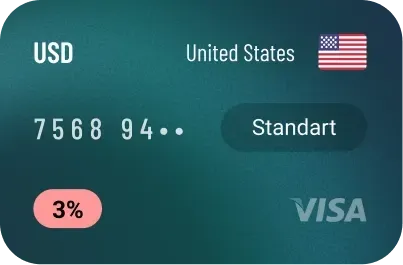
- BINs from Estonia, Hong Kong, Singapore, the US, Canada and the UK
- Personal card works with Apple Pay and Google Pay
Watch out
- $5 to issue and $5 a month for every card
- 4% fee on every card top-up, so $1,000 of spending costs $40
- No cashback or rewards on any spending
- Taking money back off a card costs 3% and waits 14 days
Pay2.House Virtual Card is a prepaid virtual card that you fund with USDT and use for ad platforms, subscriptions and online services. Each card costs $5 to issue and $5 a month, every top-up costs 4%, and the card pays no cashback. The Standard card needs no identity verification.
Pay2.House is built mainly for media buyers who pay for Meta, Google and TikTok ads, but it also sells cards for Netflix, Spotify, ChatGPT and other subscriptions, and says the service works for individuals as well as teams. You can choose the card's country and BIN from more than 50 options, which matters when a platform rejects cards from certain issuers.
Pay2.House Virtual Card cashback
Pay2.House Virtual Card pays no cashback, points or token rewards on any payment.
The service has no reward tiers, and the only price break on its tariff page is a 20% discount on issuance for anyone creating 100 cards or more. Pay2.House also mentions personal promo codes from its managers and pricing plans that are still marked as coming soon, but neither adds a reward rate.
Without rewards, the card's cost is simply its fees. That is normal for virtual cards aimed at advertisers, who value high approval rates on ad accounts over anything paid back.
Pay2.House Virtual Card fees
Pay2.House Virtual Card costs $5 to issue, $5 a month per card and 4% on every top-up from your Pay2.House account to the card, according to Pay2.House's tariff page.
Money reaches a Pay2.House card in two steps: you first deposit USDT on the TRC20 network to your Pay2.House account, which is free from 5 USDT, and then move funds from that balance onto a card. The second step carries the 4% fee, so loading $500 onto a card costs $20, and a $1,000 monthly ad budget costs $40 a month, or $480 a year.
The fixed fees depend on how many cards you keep. One card held for a year costs $65 including issuance, before any top-up fees. Ten cards cost $50 to issue and $50 a month to keep. Each card needs at least $50 per top-up, and your account needs $50 of balance for every active card.
Pay2.House says each BIN has its own rates, shown in the card details before you issue it, and managers hand out personal promo codes with better terms. Pay2.House doesn't list a currency conversion fee for card payments in other currencies.
Getting money back out also costs. Moving funds from a card back to your account costs 3%, and withdrawing USDT from the account to an external wallet costs 8 USDT plus 0.5%.
Pay2.House Virtual Card ATM withdrawal fees
Pay2.House Virtual Card can't be used to withdraw cash: the Standard card is for online payments only, and there is no physical card.
The Personal card can be added to Apple Pay and Google Pay for shop payments, but Pay2.House doesn't describe cash withdrawals or publish an ATM fee for it. If you need cash from crypto, a card with a physical version and a published ATM fee is the better tool.
Is Pay2.House Virtual Card safe?
Pay2.House Virtual Card is custodial: your USDT is held in your Pay2.House account and on your cards, and Pay2.House controls both.
Pay2.House doesn't name the company behind the service, its licences or the banks that issue its cards in its user agreement, AML policy or site footer. The user agreement lets Pay2.House freeze a balance while it reviews suspected illegal activity, block accounts permanently and settle disputes under its own procedure. Two-factor authentication is mandatory for logins and payments.
The card rules are strict for a prepaid product. Refunds from a card are only possible 14 days after its last transaction, including declines, and repeated declines can temporarily freeze part of your account balance. Pay2.House sets a maximum decline rate of 35% and asks you to unlink cards from services before closing them. Keep only the budget you need on the platform.
Who should get Pay2.House Virtual Card
Pay2.House Virtual Card suits advertisers and small teams who need many separate cards for ad accounts and online services, choose BINs by country, and fund everything with USDT.
Instant issuance, the choice of BINs, team budgets and an API for creating cards automatically are what Pay2.House is built around. The Standard card's lack of identity checks also helps people who just want a disposable card for a single subscription.
For personal spending, the fees are hard to justify. A single card kept for a year and loaded with $200 a month costs $65 in card fees and $96 in top-up fees, which is $161 for $2,400 of spending, or almost 7%. The comparison below shows cheaper cards in your country.


Where Pay2.House Virtual Card is available
Pay2.House Virtual Card is open to users in most countries, but Pay2.House's AML policy rules out 27 high-risk countries, including Nigeria, South Africa, the Philippines, the United Arab Emirates and Vietnam.
The rest of the list covers Afghanistan, Barbados, Burkina Faso, Cameroon, the Cayman Islands, DR Congo, Gibraltar, Haiti, Jamaica, Jordan, Mali, Mozambique, Myanmar, Panama, Senegal, South Sudan, Syria, Tanzania, Trinidad and Tobago, Uganda, Vanuatu and Yemen.